What Makes Lifepo4 Energy Storage Battery the Best Choice?
The emergence of the Lifepo4 Energy Storage Battery marks a significant advancement in energy technology. Dr. Emily Chen, a renowned expert in battery science, states, "Lifepo4 batteries offer unparalleled safety and longevity for energy storage." This statement encapsulates the core benefits of these batteries in a rapidly evolving energy landscape.
Lifepo4 Energy Storage Batteries stand out due to their thermal stability and long cycle life. They can endure a higher number of charge and discharge cycles compared to other lithium-ion variants. This longevity makes them ideal for both residential and commercial applications. Dr. Chen's insights highlight the importance of reliability in energy storage solutions, especially as we transition towards sustainable energy.
However, challenges remain. The initial cost of Lifepo4 batteries can be higher than traditional options. Consumers must consider this upfront investment against long-term savings. As more people explore energy storage, understanding these nuances becomes critical for making informed decisions. The Lifepo4 Energy Storage Battery ultimately represents a blend of innovation and practicality, inviting a deeper exploration into its transformative potential in our energy future.

Advantages of Lifepo4 Batteries Over Traditional Lithium-ion Batteries
Lifepo4 batteries stand out due to their impressive safety features. They are stable and less prone to overheating compared to traditional lithium-ion batteries. This is crucial in preventing accidents, especially in applications like electric vehicles and renewable energy systems. Enhanced thermal stability means Lifepo4 batteries hold up better under stress.
Another significant advantage lies in their lifecycle. Lifepo4 batteries offer greater longevity, typically lasting over 2000 charge cycles. On the other hand, conventional lithium-ion batteries tend to degrade faster. This durability translates to lower replacement costs and less environmental impact over time. Users can enjoy reliable performance without frequent replacements.
However, there are some challenges. Lifepo4 batteries can be bulkier and heavier than their lithium-ion counterparts. This might limit their application in compact devices. Additionally, while the initial investment can be high, the long-term savings often offset this. The balance of weight and cost needs careful consideration for each use case.
Lifecycle and Longevity: Lifepo4 Battery Performance Statistics
Lifepo4 batteries are gaining attention for their remarkable lifecycle and longevity. Studies indicate that these batteries can deliver over 2,000 charge cycles while maintaining over 70% capacity. This contrasts sharply with traditional lithium-ion batteries, which typically only reach 500-1,000 cycles before substantial capacity loss.
In real-world applications, Lifepo4 batteries often last up to a decade. Their stability at various temperatures further contributes to their appeal. Research shows that Lifepo4 batteries can operate efficiently in environments ranging from -20°C to 60°C. In high-temperature conditions, they exhibit less degradation compared to conventional batteries.
However, limitations exist. Some users report slower charging times than expected, which can be frustrating. The performance in extreme cold also requires consideration, as capacity may dip. Despite these challenges, the overall performance statistics highlight Lifepo4 batteries as a reliable option for energy storage. The combination of long lifecycle, good thermal stability, and consistent performance makes them a strong choice in various applications.
Safety Features of Lifepo4 Batteries Compared to Other Energy Storage Solutions
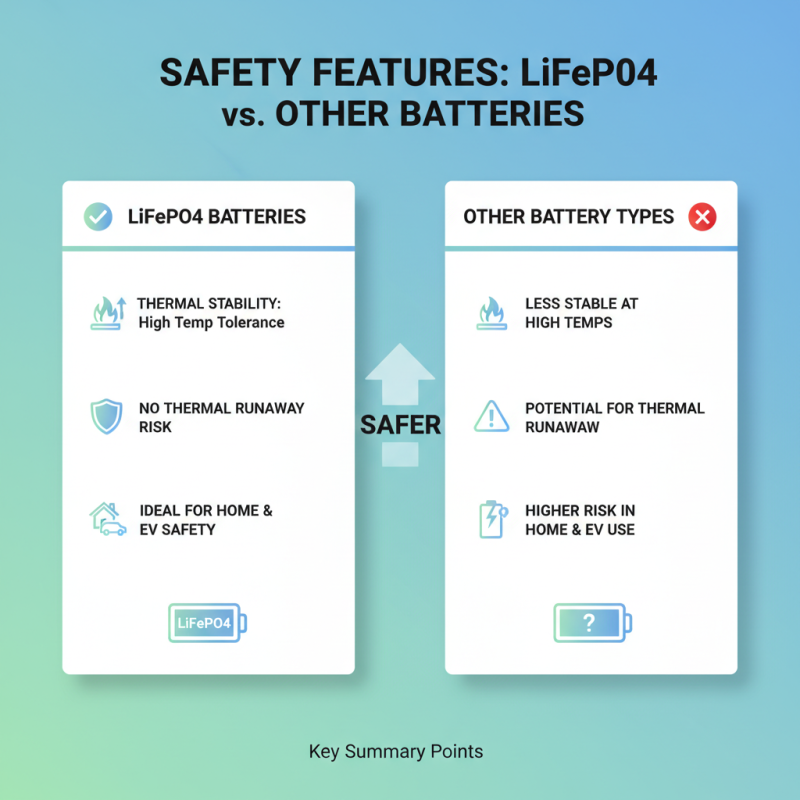
Lifepo4 batteries are gaining attention for their safety features. A key aspect of these lithium iron phosphate batteries is their thermal stability. Research indicates that Lifepo4 cells can withstand higher temperatures without risk of thermal runaway. This stability is critical for applications in homes or electric vehicles, where safety concerns are paramount.
Compared to other energy storage solutions, Lifepo4 shows a dramatic difference in safety. Traditional lithium-ion batteries can overheat and catch fire, especially under stress. A study from the Battery University suggests that Lifepo4 batteries have a 30% lower risk of fire than their lithium-ion counterparts. This statistic emphasizes the importance of material choice in battery design.
Safety is not the only concern. Lifepo4 batteries also offer reliable performance over their lifespan. They can endure over 2,000 charge cycles with minimal degradation. Conversely, some other technologies may falter after only 1,000 cycles. However, Lifepo4 is not perfect. Issues like lower energy density compared to other lithium solutions require attention. Continuous improvements and rigorous testing are necessary to refine this technology further and enhance its reliability.
Environmental Impact and Sustainability of Lifepo4 Technology
Lithium Iron Phosphate (LiFePO4) technology has gained traction due to its minimal environmental impact. Compared to traditional lithium-ion batteries, LiFePO4 batteries offer a more sustainable solution. For instance, they exhibit lower carbon footprints during production. A report from the International Energy Agency indicates that the carbon emissions from LiFePO4 are approximately 20% lower than other lithium-ion options. This is a significant advantage in an era striving for sustainability.
Another notable aspect of LiFePO4 technology is its longevity and safety. These batteries can withstand over 2000 charge cycles, thus reducing waste. A study from the Clean Energy Institute suggests that longer battery life translates to fewer replacements. This leads to decreased demand for raw materials and lower overall environmental degradation. However, the raw materials used, like iron, are still subject to mining impacts, which warrant further assessment.
While LiFePO4 is not devoid of environmental concerns, its overall sustainability profile is superior. The technology provides a balanced approach between efficiency and environmental responsibility. Continuous innovation in the recycling of LiFePO4 batteries could further enhance their sustainability. As experts push for greener technologies, LiFePO4 holds promise, but challenges remain in its supply chain management.
Cost-Effectiveness of Lifepo4 Batteries in Renewable Energy Applications
LiFePO4 batteries stand out in renewable energy applications primarily because of their cost-effectiveness. A report from the International Energy Agency indicates that energy storage costs have declined by nearly 90% since 2010. LiFePO4 systems show significant price advantages, often reducing overall project costs. Their longevity, with a lifespan of up to 10,000 cycles, helps in maximizing return on investment.
Tips: Consider the total cost of ownership. This includes purchase, installation, maintenance, and replacement over time. Look at various financing options for renewable projects that may offer lower upfront costs.
Furthermore, LiFePO4 batteries do not compromise on safety. They are less prone to thermal runaway compared to other lithium-ion chemistries. This reliability is crucial in avoiding costly accidents in energy systems. The performance consistency under varying temperatures keeps maintenance needs low, adding further to their economic appeal.
However, some critics point to the energy density. LiFePO4 batteries are bulkier, which can be a drawback in space-constrained installations. Balancing cost against efficiency is essential for design consideration. Always evaluate your specific energy needs before making a choice.
Cost-Effectiveness of LiFePO4 Batteries in Renewable Energy Applications